A business suit is worn for hours: in air-conditioned offices, on the commute, and now and then under the Jakarta sun. That is why the fabric matters as much as the cut. Even a well-cut suit will feel stuffy or crease quickly if the cloth does not suit the way it is worn.
This guide helps you choose a formal suit fabric for the office — for a personal suit or a team uniform.
1. Start with the purpose, not the colour
Before looking at swatches, answer three simple questions:
- How often will the suit be worn? A suit worn every day needs a durable, crease-resistant cloth.
- Where will it be worn? Air-conditioned rooms, outdoors, or both.
- For one person or a whole team? Uniforms for many employees call for consistent, easy-care fabrics.
2. Know the common fabrics
| Fabric | Strengths | Keep in mind | Best for |
|---|---|---|---|
| Wool | Breathable, naturally elastic, drapes well, resists creasing | Needs more careful care | Business suits and formal events |
| Wool blends (e.g. wool-polyester) | More durable, easy care, more economical | Slightly less breathable than pure wool | Daily uniforms and frequently worn suits |
| Cotton | Cool, smart-casual, comfortable in heat | Creases more easily | Blazers and relaxed daytime events |
| Linen | Very breathable and light | Creases very easily, less formal | Outdoor daytime events |
For office suits, lightweight wool and wool blends usually offer the best balance of comfort, appearance and durability.
3. Mind the cloth weight
Suit fabric weight is usually given in grams per metre (g/m). The lighter the cloth, the cooler it wears — but cloth that is too light may not drape as neatly. For a tropical climate like Jakarta’s, light to mid-weight cloths of roughly 220–280 g/m tend to be the most comfortable for everyday office wear.
4. Weave and fibre fineness
Open weaves such as hopsack or fresco let air circulate and wear cooler. A twill weave is denser and more crease-resistant, which suits frequently worn suits.
You may see labels like “Super 110s” or “Super 130s”. These indicate the fineness of the wool fibre: the higher the number, the finer and softer the cloth — but also the more delicate. For everyday business suits, a mid-range number is usually more durable than the finest option.
5. Versatile colours and patterns
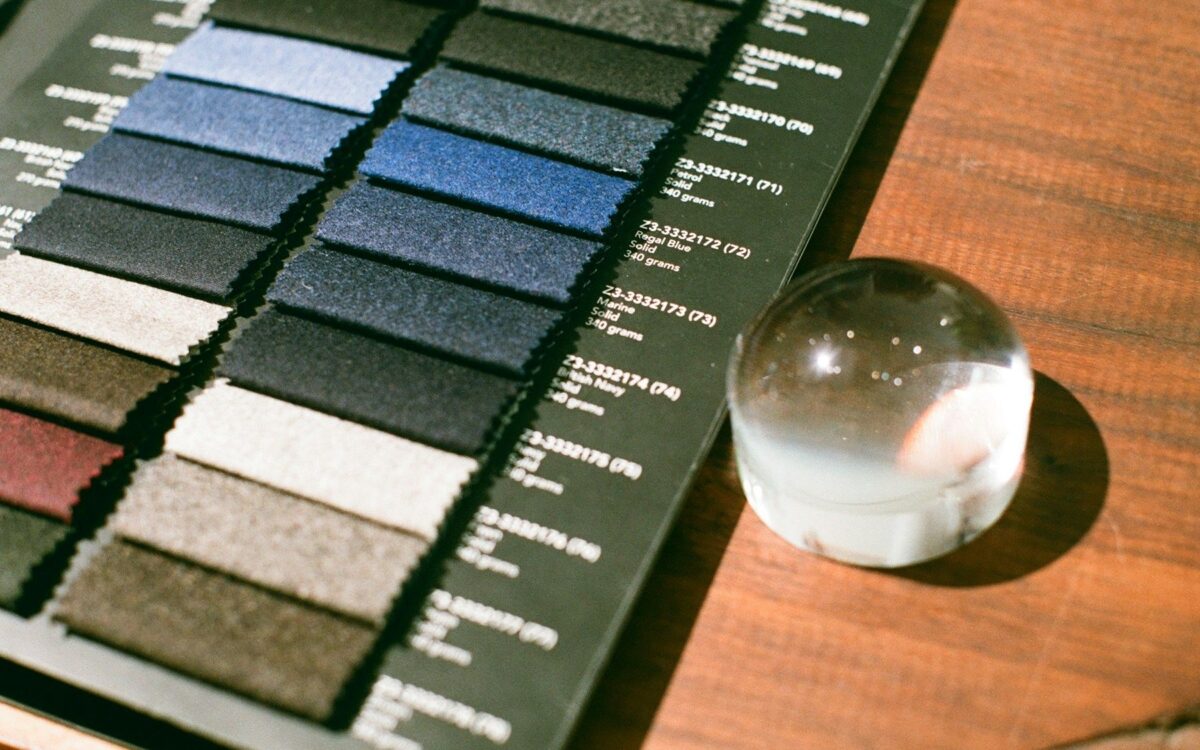
Navy and charcoal grey are the most versatile office colours: formal, easy to combine and right for almost any occasion. Subtle patterns such as a fine pinstripe or birdseye add character without looking loud.
For uniforms, make sure enough fabric is available from a single dye lot, so there are no tonal differences between employees.
6. Consider the care
- Hang the suit on a broad-shouldered hanger after wearing, and give it a day to rest.
- Brush the cloth regularly to lift dust.
- Dry clean only when needed — too often can shorten the life of the fabric.
- For uniforms worn daily, consider two suits per employee so they can be rotated.
In short
- Decide on the purpose and how often the suit will be worn first.
- For offices in Jakarta, lightweight wool or wool blends around 220–280 g/m are a good starting point.
- Choose breathable weaves for comfort and twill for durability.
- Navy and charcoal are the safest, most versatile choices.
The best fabric is the one that suits the way you wear it. During a consultation at The Republic Tailor you can see and feel the swatches in person, and we help you choose for your purpose, climate and budget. Book a consultation or, for your team, request a corporate uniform quote.